
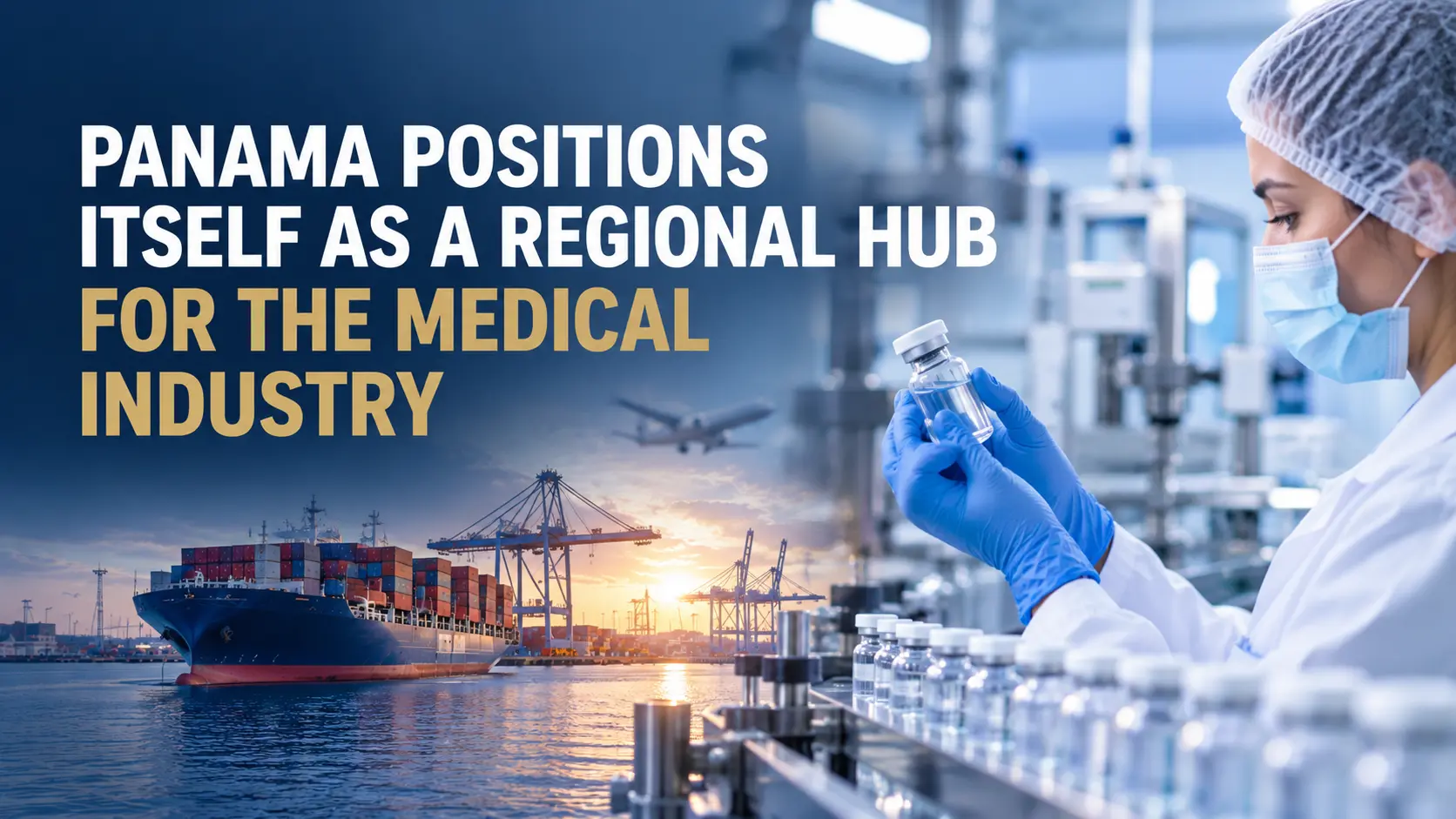

The Panama medical industry hub is moving from ambition to execution, with the government leveraging the country’s connectivity, logistics infrastructure, and financial system to attract pharmaceutical manufacturing, medical device production, and specialized healthcare investment across Latin America.
Panama is advancing the development of an ecosystem focused on the medical and pharmaceutical industry, creating opportunities to connect companies, professionals, investors, and specialized suppliers across the region.
Table of Contents
Key Facts About the Panama Medical Industry Hub
- Initiative: HospavIA 2027, an international trade show, strategic summit, and networking initiative for the healthcare sector
- Lead agency: Ministry of Commerce and Industries (MICI), with Vice Minister of Commerce Omar Torres De León at the official launch
- Health sector counterpart: Ministry of Health (MINSA), represented by Vice Minister Manuel Zambrano, who has met with pharmaceutical manufacturers from Argentina to present Panama’s competitive advantages
- Flagship investment example: Haleon’s expansion in Juan Díaz, announced in August 2026, with more than B/.30 million to modernize the plant and double production capacity for Latin America and the Caribbean
- Production target: approximately 900 million paracetamol tablets per year, for distribution across 25 markets in Latin America and the Caribbean
- Employment impact: more than 100 new direct and indirect jobs, on top of the plant’s current workforce of about 220
- Core infrastructure assets: the Panama Canal, the Colón Free Trade Zone, and Panama’s national air and maritime logistics platform
A New Chapter for the Healthcare Sector
In this context, HospavIA 2027 emerges as an initiative that will bring together an international trade show, a strategic summit, and networking opportunities to promote innovation, technology, and business opportunities in the healthcare sector.
The goal is to strengthen Panama’s role as a logistics, commercial, and business hub for the medical industry in Latin America. At the official launch, Vice Minister Torres De León called the initiative promising, underscoring the government’s confidence in its potential.
Panama’s Competitive Advantages
The country’s geographic location remains the strongest argument for a Panama medical industry hub. Air and maritime connectivity, the Panama Canal, the Colón Free Trade Zone, and the national logistics platform allow the country to efficiently serve multiple markets throughout the region.
These advantages are complemented by a well-developed financial system, specialized business services, and infrastructure that facilitates the importation, distribution, and commercialization of healthcare-related products. Panama’s health authorities have already put this pitch in front of international manufacturers: MINSA’s meeting with Argentine pharmaceutical companies focused specifically on the country’s advantages as a future pharmaceutical and medical device hub for the region.
An Industry That Requires Specialized Infrastructure
Developing a medical hub goes far beyond hospitals and healthcare facilities. The industry requires pharmaceutical manufacturing plants, medical device facilities, laboratories, distribution centers, specialized storage, office space, and logistics services.
There are also opportunities for the processing, packaging, and regional distribution of pharmaceuticals and medical products from Panama. One example of this trend is Haleon’s expansion in Juan Díaz, which includes an investment of more than B/.30 million to expand and modernize its facility, as well as double its production capacity to supply markets across Latin America and the Caribbean.
Regulation is part of the equation. Within the Ministry of Health, dedicated bodies such as the National Directorate of Pharmacy and Drugs and the National Directorate of Medical Devices handle registration and supervision for these product categories — the institutional machinery a Panama medical industry hub needs if manufacturers are to register products locally and distribute them regionally.
From Distribution to Production
The focus on the medical industry represents an evolution of Panama’s traditional role as a logistics hub. A Panama medical industry hub would serve not only as an entry and distribution point, but also as a platform for manufacturing, processing, storing, and developing solutions designed for regional markets.
This growth could attract new investment and generate demand for industrial infrastructure, laboratories, logistics centers, office space, and business facilities adapted to the sector’s specific requirements — a shift that parallels the opportunity Panama is already pursuing to manufacture and export to the United States more broadly.
An Opportunity to Attract Higher-Value Investment
Building a Panama medical industry hub could help diversify the economy and attract operations related to technology, innovation, and specialized manufacturing. It could also support the creation of skilled jobs and expand the participation of local suppliers in regional supply chains.
Panama already connects markets. The next step is to leverage that connectivity to manufacture, develop, and distribute solutions that serve the needs of those same markets — building on the same logistics backbone, including the Colón Free Trade Zone’s ongoing expansion, that already supports the country’s broader trade ambitions.
Frequently Asked Questions
What is HospavIA 2027?
HospavIA 2027 is an initiative combining an international trade show, a strategic summit, and networking opportunities focused on innovation, technology, and business in Panama’s healthcare and medical industry.
Why is Panama positioning itself as a medical industry hub?
Panama is leveraging its air and maritime connectivity, the Panama Canal, the Colón Free Trade Zone, and its national logistics platform to attract pharmaceutical manufacturing, medical device production, and distribution operations serving Latin America.
What government agencies are leading this effort?
The Ministry of Commerce and Industries (MICI), through Vice Minister Omar Torres De León, and the Ministry of Health (MINSA), through Vice Minister Manuel Zambrano, are both promoting Panama’s advantages to international pharmaceutical and medical device companies.
What investment already reflects this trend?
Haleon’s expansion in Juan Díaz, announced in August 2026, is a concrete example: more than B/.30 million to modernize the plant and double production capacity, targeting roughly 900 million paracetamol tablets a year for 25 markets across Latin America and the Caribbean, plus over 100 new direct and indirect jobs.
What kind of infrastructure does a medical hub require?
Beyond hospitals, the industry needs pharmaceutical manufacturing plants, medical device facilities, laboratories, distribution centers, specialized storage, office space, and logistics services adapted to healthcare products.
Sources and Further Reading
- Ministry of Commerce and Industries (MICI): Panamá se proyecta como hub regional de la industria médica
- Ministry of Health (MINSA): Minsa expone las ventajas competitivas de Panamá como futuro hub farmacéutico
- MICI: Moltó visita planta de Haleon en Panamá — estrategia de inversión extranjera en el sector salud
- Haleon official site

